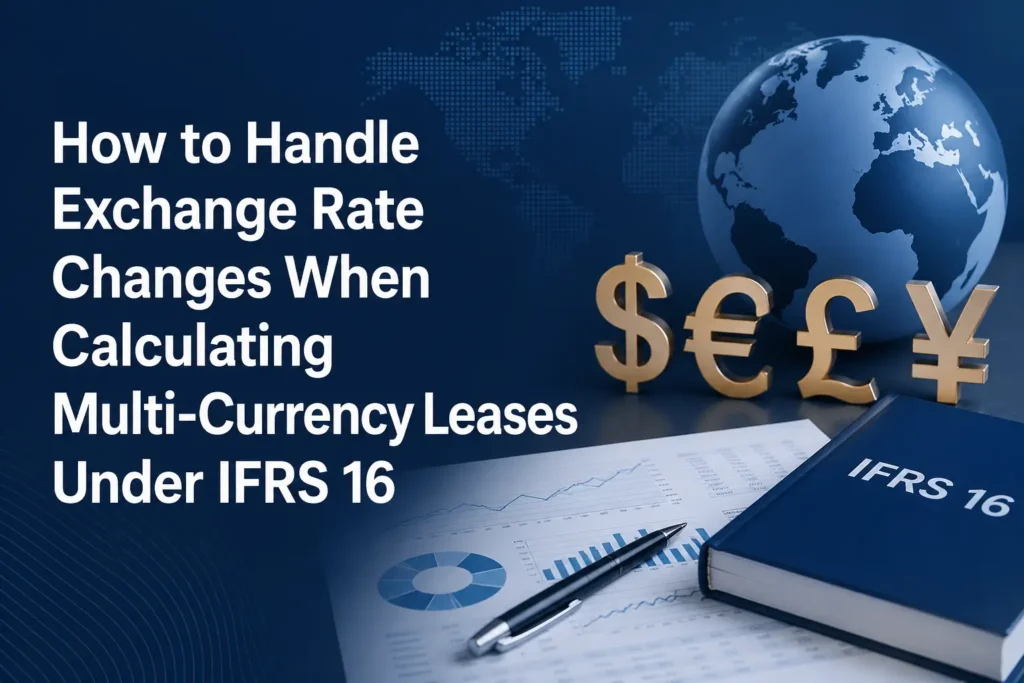
If your business operates across multiple countries, you already know that dealing with different currencies adds a layer of complexity to your financial reporting. When it comes to leases, IFRS 16 (International Financial Reporting Standard 16) adds even more to consider, especially when exchange rates keep changing. In this guide, we will walk you through how to handle exchange rate changes when calculating multi-currency leases under IFRS 16 in a simple and practical way.
What Is IFRS 16 and Why Do Exchange Rates Matter?
IFRS 16 is the accounting standard that governs how companies recognize, measure, and report leases on their financial statements. It requires businesses to bring most leases onto the balance sheet by recognizing a right-of-use (ROU) asset and a corresponding lease liability.
When a lease is denominated in a foreign currency, things get more complicated. Exchange rates between currencies change daily. This means the value of your lease liability in your functional currency (the currency your business primarily operates in) will also change over time. If you do not account for this properly, your financial statements could be inaccurate and misleading.
Understanding Functional Currency vs. Lease Currency
Before diving into the mechanics, it is important to understand the difference between two key terms:
- Functional Currency: The primary currency of the economic environment where your company operates. For example, if your business is based in the UK, your functional currency is likely the British Pound (GBP).
- Lease Currency: The currency in which the lease payments are actually made. If you lease office space in Germany, the lease might be denominated in Euros (EUR).
When these two currencies are different, you have a foreign currency lease. IFRS 16 requires you to track and report exchange rate differences throughout the lease term.
Initial Recognition: Setting the Baseline
At the start of the lease (called the commencement date), you need to translate the lease liability into your functional currency using the spot exchange rate on that date. The spot rate is simply the current exchange rate available in the market at that moment.
For example, if you sign a lease with monthly payments of USD 5,000 and your functional currency is GBP, you would convert the total lease liability using the GBP/USD exchange rate on the day the lease begins. This gives you your initial lease liability in GBP.
The right-of-use asset is also recognized at this initial translated amount. After this point, the ROU asset is not remeasured for exchange rate changes (unless there is a lease modification). Only the lease liability continues to be updated.
Subsequent Measurement: Updating the Lease Liability
This is where most of the complexity lies. At each reporting date (such as month-end or year-end), you are required to remeasure the lease liability using the closing exchange rate on that date. The closing rate is the exchange rate at the end of the reporting period.
The steps for subsequent measurement are straightforward once you understand the flow:
- Calculate the lease liability in the foreign currency as you normally would, reducing it by principal repayments and adding interest.
- Convert that updated foreign currency balance into your functional currency using the closing exchange rate.
- Compare the new translated balance with the carrying amount from the previous period.
- Record the difference as a foreign exchange gain or loss in your profit and loss (income statement).
This foreign exchange gain or loss is recognized in the income statement as part of finance costs or other income/expenses, not as part of the ROU asset.
How to Treat the Right-of-Use Asset
Under IFRS 16, the right-of-use asset is treated differently from the lease liability when it comes to exchange rate changes. The ROU asset is not retranslated at each reporting date. Instead, it is held at its historical cost in your functional currency and is depreciated over the lease term.
This means there will naturally be a mismatch between the ROU asset and the lease liability over time, particularly as exchange rates fluctuate. This mismatch creates the foreign exchange gain or loss that flows through the income statement, which is the correct accounting treatment under IAS 21 (the standard that deals with foreign currency transactions) as applied alongside IFRS 16.
Practical Example: Step by Step
Let us walk through a simple example to make this clearer.
Scenario: A company based in Australia (functional currency: AUD) leases equipment from a US supplier. The lease requires annual payments of USD 10,000 for 3 years. The AUD/USD rate at commencement is 0.70.
- Initial lease liability in USD = USD 27,232 (present value of future payments at a 5% discount rate).
- Converted to AUD at commencement rate: AUD 38,903.
- ROU asset is recorded at AUD 38,903 and depreciated over 3 years.
At the end of Year 1, the AUD/USD rate has moved to 0.65 (AUD weakened against USD).
- Lease liability in USD after Year 1 payments = USD 18,594.
- Retranslated to AUD at 0.65 = AUD 28,606.
- Previous carrying amount in AUD = AUD 27,248 (after making the Year 1 payment).
- Foreign exchange loss = AUD 1,358, recorded in the income statement.
This loss reflects the fact that the AUD weakened, making the USD-denominated liability more expensive to settle.
Key Disclosures Required Under IFRS 16
IFRS 16 requires companies to disclose information about their leases in the financial statement notes. When foreign currency leases are involved, this includes:
- The carrying amount of the ROU asset by class of underlying asset.
- The total lease liability split into current and non-current portions.
- A maturity analysis of lease liabilities.
- Information about significant exchange rate risks related to lease commitments.
Providing clear disclosures helps investors and stakeholders understand the potential impact of exchange rate movements on your financial position.
Common Mistakes to Avoid
Many businesses make errors when handling foreign currency leases. Here are the most common ones to watch out for:
- Retranslating the ROU asset along with the lease liability: Remember, only the lease liability is retranslated at closing rates. The ROU asset stays at its historical rate.
- Using incorrect exchange rates: Always use the spot rate at commencement for initial recognition and the closing rate for subsequent reporting periods.
- Misclassifying foreign exchange gains or losses: These should go through the income statement, not through other comprehensive income (OCI).
- Forgetting to update the effective interest calculation: The interest on the lease liability should still be calculated on the foreign currency balance first, before conversion.
Tips for Simplifying Multi-Currency Lease Accounting
Dealing with exchange rate changes in multi-currency leases can be time-consuming. Here are a few practical tips to streamline the process:
- Use lease accounting calculator that takes the complexity out of multi-currency leases by automatically applying the correct exchange rates at each reporting date, so your IFRS 16 numbers are always accurate.
- Set up a clear schedule that tracks each foreign currency lease separately, including the lease liability balance in both the foreign currency and the functional currency.
- Reconcile foreign exchange differences regularly, ideally at each reporting period, rather than waiting until year-end.
- Work closely with your treasury and finance teams to understand the company’s exposure to foreign exchange risk from lease obligations.
Final Thoughts
Handling exchange rate changes in multi-currency leases under IFRS 16 requires a clear understanding of how the lease liability and the right-of-use asset are treated differently. By using the correct exchange rates at each stage, properly recording foreign exchange gains and losses in the income statement, and maintaining detailed records for each lease, you can ensure your financial statements remain accurate and compliant.
Whether you manage a few foreign currency leases or dozens across multiple jurisdictions, following the structured approach outlined in this guide will help you stay on top of your lease accounting obligations under IFRS 16. When in doubt, consult with a qualified accountant or IFRS specialist who can provide guidance tailored to your specific situation.