Managing leases used to be fairly simple, you signed a contract, made payments, and moved on. But since the International Accounting Standards Board introduced IFRS 16, everything changed. This accounting standard, which came into effect in January 2019, now requires businesses to recognize most leases directly on their balance sheets.
For many finance teams, the transition has not been smooth. Without the right systems in place, companies are making costly mistakes — some of which go unnoticed until an audit or financial review. The good news? A proper IFRS 16 calculation tool can prevent most of these errors before they happen.
Here are five of the most common and costly lease accounting mistakes, and how the right software can help you avoid them.
Mistake #1: Misidentifying Whether a Contract Contains a Lease
One of the biggest errors companies make is failing to correctly identify which contracts actually contain a lease under IFRS 16. The standard defines a lease as a contract that gives the right to control the use of an identified asset for a period of time in exchange for payment. That sounds simple, but in practice, many service agreements, outsourcing contracts, and supplier deals can also qualify.
If your team is reviewing contracts manually, especially when dealing with hundreds or thousands of agreements — it is easy to miss leases buried within larger service arrangements.
How an IFRS 16 tool helps: A good lease accounting platform uses structured data fields and guided workflows that prompt your team to assess each contract against IFRS 16 criteria. This reduces human error and ensures nothing slips through the cracks.
Mistake #2: Incorrect Calculation of the Lease Liability
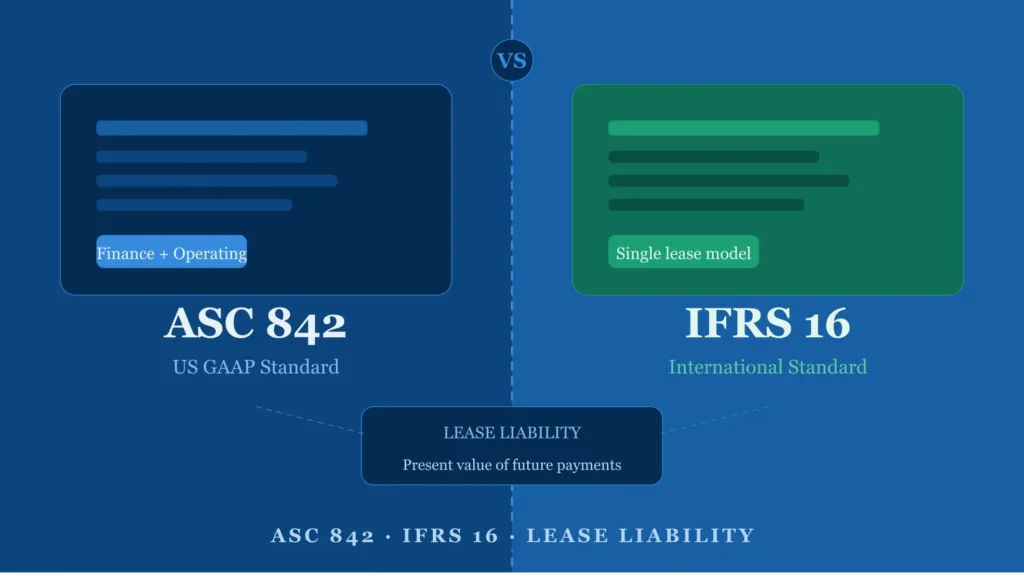
Getting the numbers wrong on your lease liability is one of the costliest mistakes a business can make. Under IFRS 16, the lease liability must be calculated as the present value of future lease payments, discounted using the interest rate implicit in the lease or, if that cannot be determined, the lessee’s incremental borrowing rate (IBR).
Many companies struggle with:
- Using the wrong discount rate
- Forgetting to include variable lease payments that depend on an index
- Miscounting the lease term, especially when renewal options are involved
Even a small error in the discount rate can result in significantly misstated financials — which could trigger audit findings or restatements.
How an IFRS 16 tool helps: A reliable IFRS 16 solution automates lease liability calculations, applies the correct discount rates, and flags renewal options for management judgment. It eliminates the need for complicated manual spreadsheets that are prone to formula errors.
Mistake #3: Failing to Reassess Lease Terms and Modifications
IFRS 16 is not a one-time calculation. Leases must be reassessed whenever there is a significant change — such as a lease modification, a change in the lease term, or a change in lease payments tied to an index or rate.
Many companies set up their leases at inception and then forget to update them. This is especially common in organizations managing large lease portfolios across multiple locations. When a lease is extended, shortened, or renegotiated, the accounting entries need to be updated accordingly. Missing these reassessments means your balance sheet is carrying incorrect figures.
How an IFRS 16 tool helps: A proper IFRS 16 platform keeps track of lease lifecycle events and sends automated alerts when a reassessment is needed. Modifications can be recorded quickly, and the system recalculates the right-of-use (ROU) asset and liability automatically — keeping your books accurate at all times.
Mistake #4: Poor Management of the Right-of-Use Asset
The right-of-use (ROU) asset represents your right to use a leased asset over the lease term. Under IFRS 16, this asset must be measured at cost initially and then depreciated over the life of the lease. Many companies make mistakes such as:
- Applying the wrong depreciation period (e.g., using the useful life of the asset instead of the lease term)
- Failing to test the ROU asset for impairment when required
- Not accounting for initial direct costs or lease incentives properly
These errors directly affect both the income statement (through depreciation and interest charges) and the balance sheet.
How an IFRS 16 tool helps: IFRS 16 software handles ROU asset tracking, depreciation scheduling, and impairment prompts all in one place. Finance teams can view asset schedules by lease, portfolio, or entity — giving them full visibility and control.
Mistake #5: Inadequate Disclosures in Financial Statements
IFRS 16 requires extensive disclosures in financial statements. Companies must provide information about their leasing activities, including total lease liabilities, maturity analysis, expenses recognized, and future commitments. Many businesses — particularly smaller ones — underestimate just how detailed these disclosures need to be.
Incomplete or inaccurate disclosures are a red flag for auditors and investors. They can signal weak internal controls and may require costly restatements.
How an IFRS 16 tool helps: A robust IFRS 16 solution generates ready-to-use disclosure reports that align with the standard’s requirements. Instead of manually compiling data from spreadsheets, your team can produce accurate, audit-ready disclosures at the click of a button — saving time and reducing compliance risk.
Why a Proper IFRS 16 Tool Makes All the Difference
If you are still managing leases on Excel, you are taking on unnecessary risk. Spreadsheets are flexible but fragile — they break, they get corrupted, and they do not scale well when lease portfolios grow. More importantly, they require constant manual maintenance and are highly susceptible to human error.
A dedicated IFRS 16 lease accounting tool offers:
- Centralized lease repository for full visibility across your portfolio
- Automated calculations for lease liability, ROU assets, and interest expense
- Real-time reassessment alerts when lease events occur
- Built-in audit trails for compliance and governance
- One-click reporting for financial statements and disclosures
Whether you are a small business with a handful of leases or a multinational managing thousands, the right tool transforms IFRS 16 compliance from a burden into a streamlined process.
Final Thoughts
IFRS 16 compliance is non-negotiable for companies that lease assets — and the stakes are high. Errors in lease classification, liability calculations, or financial disclosures can lead to audit findings, investor distrust, and financial restatements.
The five mistakes covered in this article are among the most common — and the most avoidable. By investing in a proper IFRS 16 tool, your finance team can stay compliant, produce accurate financial statements, and spend less time firefighting and more time on strategic work.
Don’t wait for an audit to discover a problem that the right software could have prevented from the start.Share