April 11, 2026 | 8 min read
If your business signs leases whether for office space, equipment, or vehicles you’ve probably come across two big accounting standards: ASC 842 and IFRS 16. Both changed how leases are recorded on balance sheets, but they don’t work exactly the same way. Let’s break it down in plain English.
What Is a Lease Liability, Anyway?
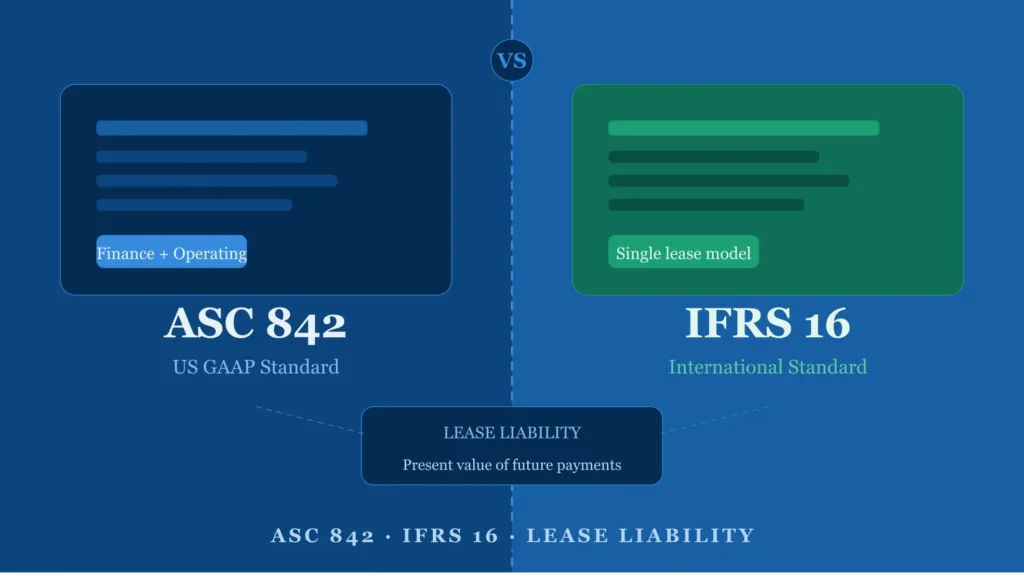
When you sign a lease, you’re making a promise to pay rent over time. A lease liability is simply the present value of all those future payments essentially, what you “owe” today for the right to use the asset. Before these standards came along, most lease obligations were tucked away in footnotes and invisible on the balance sheet. Those days are over.
Both ASC 842 and IFRS 16 require most leases to be recognized on the balance sheet meaning a right-of-use (ROU) asset and a corresponding lease liability must be recorded.
ASC 842: The US GAAP Standard
The Financial Accounting Standards Board (FASB) introduced ASC 842 as the updated lease accounting rule for US companies. The biggest change? It brought operating leases onto the balance sheet, which wasn’t required before.
Under ASC 842, there are still two types of leases from the lessee’s perspective:
Finance leases: These are similar to owning the asset. Interest and amortization are recorded separately on the income statement.
Operating leases: These stay “lease-like.” You record a single straight-line lease expense each period, and the ROU asset and liability are recognized on the balance sheet.
IFRS 16: The International Standard
The International Accounting Standards Board (IASB) released IFRS 16 around the same time. The philosophy is similar, but with one key difference: IFRS 16 does not distinguish between finance and operating leases for lessees. Nearly every lease is treated the same way like a finance lease.
That means under IFRS 16, you always recognize:
-
- Depreciation of the ROU asset
-
- Interest on the lease liability
This results in a front-loaded expense profile compared to ASC 842’s straight-line operating lease approach.
Side-by-Side: key Differences at a Glance
| Feature | ASC 842 US GAAP | IFRS 16 International |
|---|---|---|
| Lease classification | Finance & Operating (lessee) | Single model all leases treated as finance |
| Balance sheet impact | ROU asset + lease liability | ROU asset + lease liability |
| Income statement (operating lease) | Single straight-line expense | Depreciation + interest (front-loaded) |
| Short-term lease exemption | 12 months or less | 12 months or less |
| Low-value asset exemption | Not available | Available (typically under $5,000) |
| Variable lease payments | Generally excluded from liability | Generally excluded from liability |
How Is The Lease Liability Calculated?
Both standards calculate the lease liability the same fundamental way: it’s the present value of remaining lease payments, discounted using the interest rate implicit in the lease (or your incremental borrowing rate if that’s not available).
Lease liability = Present Value of (fixed payments + in-substance fixed payments + residual value guarantees + purchase options likely to be exercised)
As time passes, the liability goes down as you make payments, but you also accrue interest. So the math is similar to paying off a loan.
Use our IFRS 16 Lease Calculator to calculate your numbers in seconds, no spreadsheet needed.
Quick tip
Your discount rate choice makes a big difference. A higher rate = lower liability. Most companies use their incremental borrowing rate, so it’s worth getting this number right with your finance team or auditors.
Which Standard Applies to you?
If you’re a US public or private company reporting under US GAAP, you follow ASC 842. If you report under international standards (used in over 140 countries), you follow IFRS 16. Some global companies prepare statements under both, which adds complexity.
Why Does This Matter for your Business?
Recognizing lease liabilities on the balance sheet can affect your debt ratios, covenants with lenders, and even investor perception. It’s not just an accounting exercise, it changes how your financial health looks on paper. Getting it right is important, especially if you’re applying for credit or being evaluated for acquisition.
Bottom Line
ASC 842 and IFRS 16 both bring lease liabilities onto the balance sheet, making financial statements more transparent. The core mechanics are similar, but the income statement treatment diverges, especially for operating leases. If you’re managing leases across multiple jurisdictions, understanding both standards isn’t optional; it’s essential.