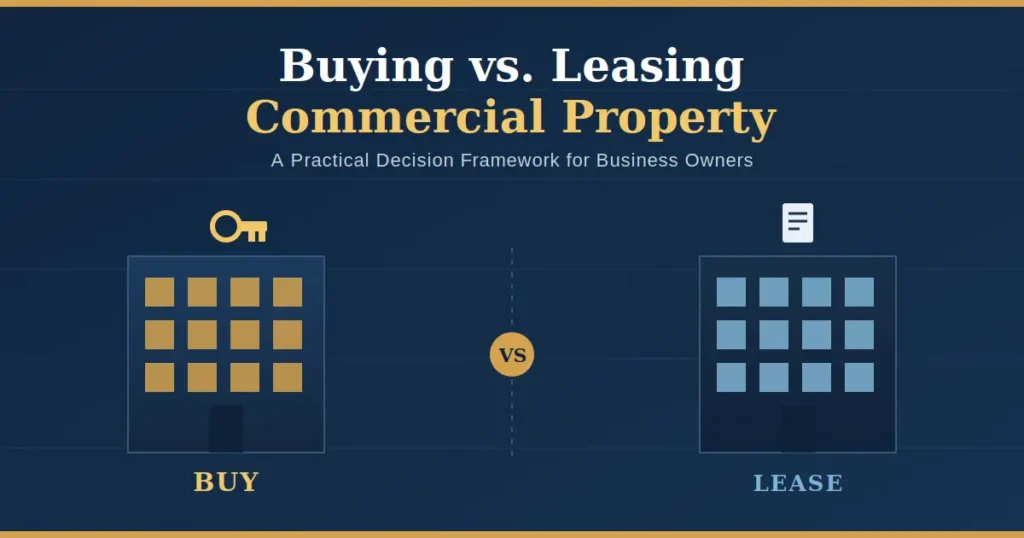
If your business has outgrown its current space — or you’re opening your first physical location — you’ll eventually hit the same fork in the road every commercial tenant or owner faces: should you buy the building or lease it?
There’s no universal right answer. A ten-location restaurant chain, a solo law practice, and a fast-growing SaaS company with 40 employees all have completely different real estate math. What follows isn’t a generic pros-and-cons list — it’s a framework for figuring out which path actually fits your business, plus the specific numbers, red flags, and negotiation levers most guides skip.
Start With One Question: How Predictable Is Your Space Need Three Years From Now?
Before you run a single financial model, answer this honestly. Buying is a bet that your space requirements — square footage, location, layout — will stay roughly stable or grow in a way the building can accommodate. Leasing is a bet that you’ll want flexibility more than you’ll want permanence.
Businesses that lean toward buying:
- Manufacturers, medical practices, and other operations with expensive, hard-to-move infrastructure
- Companies with stable, predictable headcount and space needs over a 7–10 year horizon
- Businesses in markets where commercial rents are rising faster than financing costs
- Owners who want the building itself to become a retirement or exit asset
Businesses that lean toward leasing:
- Startups and early-stage companies still validating their model or location
- Businesses expecting to double (or shrink) headcount within 3 years
- Companies entering an unfamiliar market and testing demand before committing capital
- Any business where cash is better deployed into inventory, hiring, or R&D than into a down payment
If you’re not sure which category you fall into, that uncertainty is itself useful information — it usually points toward leasing until the picture clarifies.
The Real Financial Comparison (Not Just “Rent vs. Mortgage”)
Most comparisons stop at monthly payment size. That’s incomplete. Here’s the fuller picture.
What buying actually costs
- Down payment: Commercial lenders typically require 10–30% down, with SBA 504 loans sometimes allowing as little as 10% for owner-occupied properties. Special-use properties (restaurants, gas stations, medical facilities) often require more.
- Closing costs: Appraisals, environmental assessments, title insurance, and legal fees commonly run 2–5% of the purchase price.
- Ongoing costs you now own: Property taxes, building insurance, structural maintenance, roof and HVAC replacement, and property management if you’re not self-managing.
- Opportunity cost of the down payment: Money tied up in a building isn’t available for inventory, marketing, hiring, or a cash cushion. This is the cost owners underestimate most often.
What leasing actually costs
- Security deposit and first/last month’s rent — a fraction of a down payment, but recurring at renewal or relocation.
- Common Area Maintenance (CAM) charges — in a net lease, tenants often pay a pro-rata share of property taxes, insurance, and shared-area upkeep, which can meaningfully increase the effective rent.
- Annual rent escalations — typically 2–4% per year, built into most multi-year leases. Over a 10-year lease, this compounds significantly.
- Build-out costs — tenant improvements you pay for but don’t own once the lease ends, unless negotiated otherwise.
The comparison that actually matters: cost per square foot over your realistic time horizon
Run the numbers for both scenarios over the specific number of years you expect to occupy the space — not a generic 10-year default. A lease that looks expensive over 10 years may be the cheaper option if you genuinely expect to relocate in 4.
A rough way to sanity-check the decision: calculate your breakeven point — the number of years of ownership needed for the equity built and tax benefits gained to outweigh the opportunity cost of the down payment and the ownership-related costs you wouldn’t have paid as a tenant. If your realistic time horizon in that location is shorter than your breakeven point, leasing is the financially sounder choice, even if buying “feels” like the more mature business decision.
Tax Treatment: Where the Two Paths Genuinely Diverge
- Leased space: Rent is generally fully deductible as a business operating expense in the year it’s paid.
- Owned space: You can’t deduct the purchase price outright, but you can depreciate the building (typically over 39 years for commercial property under U.S. tax law) and deduct mortgage interest, property taxes, and insurance. Cost segregation studies can sometimes accelerate depreciation on certain building components.
Neither treatment is automatically better — it depends on your tax bracket, how long you’ll hold the property, and whether you’d benefit more from immediate deductions (leasing) or a mix of smaller annual deductions plus long-term appreciation (buying). This is a conversation worth having with a CPA who understands commercial real estate specifically, not just general small business tax.
Financing Realities Most First-Time Buyers Don’t Expect
If you’re leaning toward buying, know what you’re walking into before you fall in love with a property:
- Loan terms are shorter than residential mortgages. Commercial loans commonly amortize over 20–25 years but come due in 5–10 years, requiring refinancing. Rate risk at refinancing is real — plan for it rather than assuming today’s rate holds.
- Lenders scrutinize the business, not just the property. Expect to provide 2–3 years of business financials, tax returns, and a business plan. A property with strong fundamentals won’t save a loan application if your business’s cash flow can’t support the debt service.
- SBA 504 and 7(a) loans exist specifically for owner-occupied commercial real estate and often offer lower down payments and longer fixed-rate terms than conventional commercial mortgages — worth exploring before assuming you need 25–30% down.
- Special-use properties are harder and more expensive to finance. Restaurants, medical facilities, and other properties with significant build-out needs typically face higher down payment requirements because lenders view the collateral as less liquid if you default.
Lease Negotiation Levers Most Tenants Never Use
If you’re leaning toward leasing, don’t treat the asking terms as fixed. Commercial leases are far more negotiable than residential ones, especially in a market with available inventory. Points worth pushing on:
- Length and renewal options. A shorter initial term with a renewal option at a pre-negotiated rate gives you flexibility without sacrificing long-term price certainty.
- Tenant improvement (TI) allowances. Landlords often budget a per-square-foot allowance for build-out — negotiate this up rather than accepting the first offer, especially in a space that’s sat vacant.
- Rent abatement periods. A few months of free or reduced rent during buildout is common and rarely offered unless requested.
- Exclusivity and use clauses. If you’re a retailer or restaurant, negotiate a clause preventing the landlord from leasing to a direct competitor in the same complex.
- Assignment and sublease rights. If your space needs shrink or you need to exit early, the ability to sublease or assign the lease can save you from being locked into an obligation that no longer fits.
- Cap on CAM increases. Ask for a cap on how much common area charges can rise annually — uncapped CAM is one of the most common sources of lease cost surprises.
Gross leases (flat rent, landlord covers most operating costs) and triple-net leases (tenant covers taxes, insurance, and maintenance on top of base rent) shift risk very differently — know which structure you’re being offered and price it accordingly, not just by comparing headline rent numbers.
Control, Customization, and the Trade-Offs Owners Don’t Always Anticipate
Ownership gives you the freedom to renovate, expand, sublease excess space, or change the building’s use without landlord approval. That freedom comes with full responsibility: every roof leak, HVAC failure, and code compliance issue is now your problem and your budget line, not a maintenance request sent to a property manager.
Leasing trades that control for predictability. Repairs are typically the landlord’s responsibility (structural and major systems, depending on lease type), and relocating when your needs change is a matter of not renewing rather than selling an asset — which can take months and carry transaction costs of 6–10% of the sale price when you eventually want out.
A Practical Decision Checklist
Before deciding, get honest answers to these questions:
- What’s my realistic occupancy horizon — 3 years, 7 years, 15 years?
- Can I make the down payment without weakening my cash reserves below 3–6 months of operating expenses?
- Would that down payment generate a better return deployed into the business itself (equipment, hiring, marketing) than it would sitting in home equity?
- How much does my space need to change in the next 5 years, and can this specific building accommodate that?
- What does my accountant say about how depreciation and interest deductions compare to straightforward rent deductions in my tax situation?
- Am I financially able to absorb an unplanned $20,000–$50,000 capital repair (roof, HVAC, parking lot) without disrupting operations, if I own?
If you answer these honestly and still can’t decide, that’s not a failure of the framework — it’s a signal to lease for now with a strong renewal option, and revisit the buy decision once your business’s trajectory is clearer. Real estate decisions are far more reversible when you rent than when you own; when in doubt, optionality has real value.
Frequently Asked Questions
Q1. Is it cheaper to lease or buy commercial property?
It depends on your time horizon, not just the monthly payment. Leasing is usually cheaper in the short term since there’s no large down payment, but rent escalations and CAM charges can make it more expensive than ownership over 10+ years. Calculate your breakeven point — the number of years of ownership needed for equity and tax benefits to outweigh the down payment’s opportunity cost — and compare that to how long you realistically plan to occupy the space.
Q2. How much down payment do I need to buy commercial property?
Conventional commercial mortgages typically require 10–30% down, while SBA 504 loans for owner-occupied property can go as low as 10%. Special-use properties like restaurants or medical facilities often require more because lenders see the collateral as harder to resell.
Q3. Can I negotiate a commercial lease, or are the terms fixed?
Commercial leases are far more negotiable than most tenants realize. You can typically negotiate the tenant improvement allowance, rent abatement periods, caps on annual CAM increases, renewal options at a set rate, and assignment or sublease rights — especially in a market with available inventory.
Conclusion
There’s no version of this decision that’s purely financial or purely strategic — it’s both. Run the actual numbers over your realistic time horizon, understand the financing and tax mechanics of each path, and negotiate hard regardless of which direction you choose. The businesses that regret their commercial real estate decisions are rarely the ones that leased when they should have bought, or vice versa — they’re the ones that didn’t do the math at all.