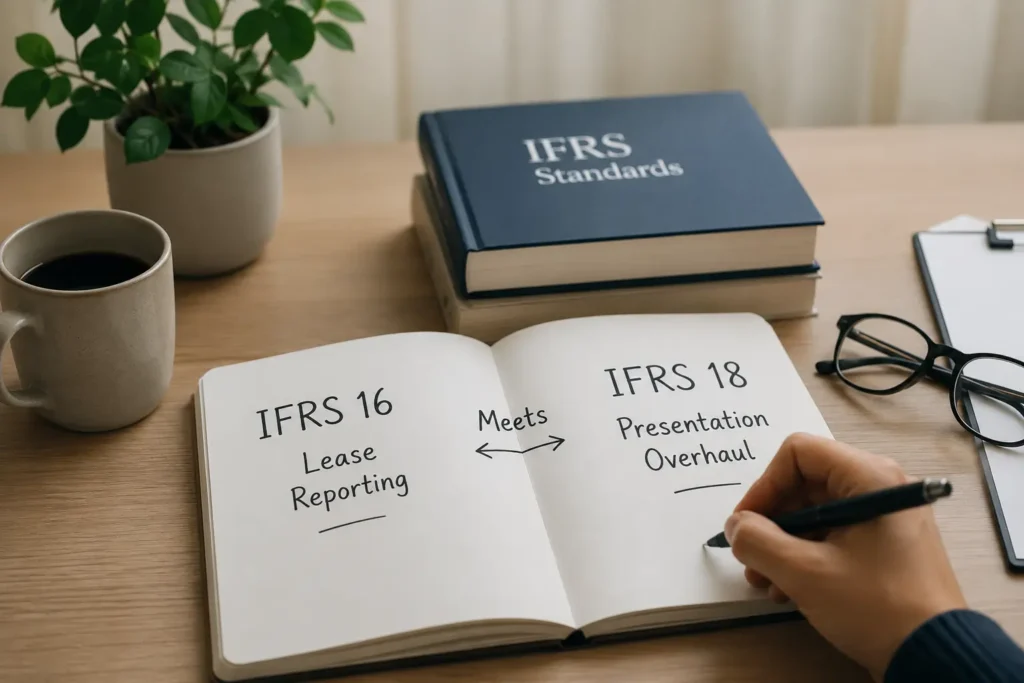
IFRS 16 changed how leases are measured and recognized. Now a new standard, IFRS 18, is changing how financial performance gets presented overall, and that has real implications for how lease related figures show up in your financial statements. If your business reports under IFRS, this is a change worth understanding well before it becomes mandatory.
What IFRS 18 Actually Is
IFRS 18, Presentation and Disclosure in Financial Statements, replaces IAS 1, the long standing standard that governed how financial statements were structured. Rather than changing how items are measured or recognized, which remains governed by standards like IFRS 16, IFRS 18 focuses on how information is organized, labeled, and presented, particularly within the statement of profit or loss.
IFRS 18 is effective for annual reporting periods beginning on or after 1 January 2027, with earlier application permitted, and it must be applied retrospectively, meaning comparative figures from the prior year will need to be restated using the new structure.
The New Categories That Affect Lease Related Items
One of the most significant changes IFRS 18 introduces is a required structure for the statement of profit or loss, organized around defined categories, generally operating, investing, and financing, along with income taxes and discontinued operations. Businesses must also present two new mandatory subtotals: operating profit, and profit before financing and income taxes.
For lease accounting, this matters because IFRS 16 splits lease costs into depreciation of the right of use asset and interest expense on the lease liability. Depreciation of the right of use asset generally falls into the operating category, while interest expense on lease liabilities is classified within the financing category. Under IFRS 18’s more prescriptive structure, this split needs to be presented clearly and consistently, rather than left to each company’s own judgment about formatting.
Why This Could Change How Lease Costs Appear to Readers
Under IAS 1, companies had more flexibility in how they structured their income statement, which meant lease related interest expense could sometimes blend in with other financing costs without much distinction, or be presented in ways that varied significantly between companies. IFRS 18’s stricter categorization and mandatory subtotals mean lease related interest will need to sit clearly within the financing category, and lease depreciation within operating, in a way that is more consistent and comparable across different companies’ financial statements.
This should make it easier for readers, including lenders and analysts who already scrutinize lease figures closely, to isolate and compare the financing impact of lease liabilities more precisely than before.
Management-Defined Performance Measures and Lease Adjustments
IFRS 18 also introduces formal requirements around management-defined performance measures, which are subtotals like adjusted operating profit that companies often use in earnings communications outside the financial statements. If a business currently presents an adjusted metric that excludes or adjusts for lease related costs, that measure will likely need to be formally disclosed in the notes under IFRS 18, along with a reconciliation back to the IFRS-defined figures.
This is a meaningful shift for companies that have historically presented lease adjusted metrics informally in investor presentations or earnings calls without the same level of formal disclosure and reconciliation now required.
Key Considerations for Lease Reporting Under IFRS 18
- Depreciation on right of use assets and interest on lease liabilities will need to be classified consistently within IFRS 18’s operating and financing categories respectively.
- Companies using adjusted performance measures that factor out lease related costs will need to assess whether those measures qualify as management-defined performance measures requiring formal disclosure and reconciliation.
- Because IFRS 18 requires retrospective application, the 2026 reporting period effectively becomes the comparative baseline that needs to be restated under the new structure.
- Systems and chart of accounts may need updates to classify lease related income and expense items correctly under the new category structure from the start.
- Cross functional coordination, including investor relations and FP&A teams, will likely be needed if lease adjusted metrics are used in external communications.
Why Preparation Should Start Now
Even though the effective date is 1 January 2027, the retrospective application requirement means businesses need comparative data structured correctly well before then. Given that lease accounting already involves detailed depreciation and interest calculations under IFRS 16, integrating those figures correctly into the new IFRS 18 presentation categories is a task that benefits from early planning rather than a last minute scramble.
Finance teams should begin reviewing how lease related income and expense items currently flow through their statement of profit or loss, and start mapping those items to the new IFRS 18 categories to identify any system or process changes needed in advance.
FAQs
1. Does IFRS 18 change how lease liabilities are measured under IFRS 16?
No. IFRS 18 does not change recognition or measurement requirements under IFRS 16. It changes how the resulting income and expense items, such as lease depreciation and interest, are categorized and presented in the financial statements.
2. When does IFRS 18 become mandatory?
IFRS 18 is effective for annual reporting periods beginning on or after 1 January 2027, with earlier application permitted, and it requires retrospective application including restated comparatives.
3. How does IFRS 18 affect companies that report adjusted metrics excluding lease costs?
If an adjusted metric used in public communications qualifies as a management-defined performance measure, it will need to be formally disclosed in the financial statement notes under IFRS 18, along with a reconciliation to the IFRS-defined figures.
Final Thoughts
IFRS 18 does not change how lease liabilities or right of use assets are measured under IFRS 16, but it does change how the resulting depreciation and interest expense need to be presented and disclosed. For businesses with significant lease portfolios, this presentation shift is worth planning for well ahead of the 2027 effective date, particularly given the retrospective restatement requirement that makes 2026 an important preparation year.