Overview
If you run a business that uses leased assets, whether it’s a retail store, a commercial property, or even heavy equipment, you’ve probably heard of IFRS 16. Since it came into effect in January 2019, this accounting standard has changed the way companies record lease agreements. And for many finance teams, it has also brought a fair share of confusion.
The good news? IFRS 16 calculations don’t have to be difficult. With the right understanding and a clear step-by-step approach, businesses across retail, real estate, manufacturing, and other industries can handle their lease accounting with confidence.
In this guide, we’ll break down IFRS 16 in plain language, walk you through the core calculations, and share practical tips for the industries most affected.
What Is IFRS 16 and Why Does It Matter?
IFRS 16 is an international financial reporting standard issued by the International Accounting Standards Board (IASB). Its main purpose is to bring lease obligations onto the balance sheet. Before this standard, companies could keep operating leases “off the books,” which made their financial position look stronger than it really was.
Under IFRS 16, almost all leases must now be recognized as:
- A Right-of-Use (ROU) Asset — representing the value of using the leased item
- A Lease Liability — representing the obligation to make future lease payments
This applies to leases of office space, retail stores, vehicles, equipment, warehouses, and more — any lease with a term exceeding 12 months and above a low-value threshold.
The Core IFRS 16 Calculation: Step by Step
Let’s simplify the calculation process into clear steps that any finance professional can follow.
Step 1: Identify the Lease
First, determine whether your contract contains a lease. Under IFRS 16, a lease exists if the contract gives your company the right to control the use of an identified asset for a period of time in exchange for payment.
Step 2: Determine the Lease Term
The lease term includes the non-cancellable period plus any optional renewal or termination periods that your company is reasonably certain to exercise. Getting this right is critical — a longer lease term means a larger liability.
Step 3: Calculate the Lease Liability
The lease liability is the present value of future lease payments, discounted using the interest rate implicit in the lease. If that rate isn’t available, use your company’s incremental borrowing rate (IBR).
Formula:
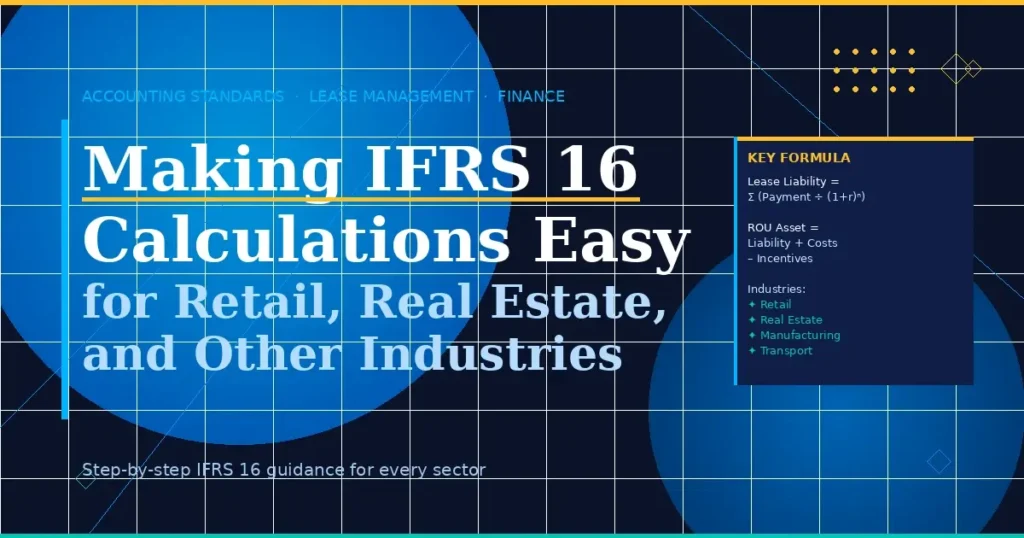
Lease Liability = Σ (Lease Payment ÷ (1 + Discount Rate)^n)
Where n is the period number and the sum covers all future payment periods.
Example:
- Monthly lease payment: $5,000
- Lease term: 3 years (36 months)
- Discount rate: 6% per annum (0.5% per month)
Using a present value calculation over 36 periods, the lease liability at commencement would be approximately $164,000.
Step 4: Calculate the Right-of-Use Asset
At the start of the lease, the ROU Asset equals the lease liability plus any initial direct costs, prepaid lease payments, and lease incentives received.
ROU Asset = Lease Liability + Initial Direct Costs + Prepaid Payments – Lease Incentives
Step 5: Recognize Interest and Depreciation
Each reporting period, you need to:
- Unwind the lease liability using the effective interest method (Lease Liability × Discount Rate = Interest Expense)
- Depreciate the ROU Asset on a straight-line basis over the shorter of the lease term or the asset’s useful life
IFRS 16 in the Retail Industry
Retail businesses are among the most heavily impacted by IFRS 16. Large retail chains often hold hundreds of store leases, making the volume of calculations significant.
Key challenges in retail:
- Variable lease payments tied to sales performance (these require careful judgement)
- Short-term leases for pop-up stores or seasonal outlets (which may qualify for exemptions)
- Lease modifications when stores are resized or renegotiated
For retail companies, automating IFRS 16 calculations using lease management software is strongly recommended. Manual spreadsheet tracking becomes error-prone at scale. Additionally, retailers must regularly reassess lease terms, especially when anchor stores close and lease break clauses become more likely to be exercised.
IFRS 16 in the Real Estate Industry
Real estate companies — whether they own properties, lease them out, or both — face unique complexities under IFRS 16.
For real estate tenants (companies leasing office or commercial space):
- Long lease durations create large balance sheet liabilities
- Rent-free periods and step-up clauses must be factored into the present value calculation
- Any lease incentives (like fit-out contributions from landlords) reduce the initial ROU Asset value
For real estate developers leasing land:
- Land leases often run for 50 to 99 years, creating substantial long-term liabilities
- The discount rate selection is especially important, as small differences can cause large changes in the liability value
Real estate companies must also clearly document their judgement on whether renewal options are “reasonably certain” to be exercised, as auditors closely scrutinize this area.
IFRS 16 in Manufacturing, Transport, and Other Industries
Beyond retail and real estate, many other sectors deal with complex lease portfolios.
Manufacturing companies often lease heavy machinery, forklifts, and production equipment. These leases tend to be for fixed terms with fixed payments, making calculations more straightforward — but the volume can be large.
Transport and logistics companies lease fleets of trucks, containers, and aircraft. Under IFRS 16, these assets now appear on the balance sheet, significantly changing key financial ratios like debt-to-equity.
Healthcare organizations lease medical equipment and clinical spaces. Some equipment leases may qualify for the low-value exemption (typically assets with a value under $5,000 when new).
In all these industries, a consistent and documented process for calculating, tracking, and reporting leases is essential for audit readiness and financial accuracy.
Common Mistakes to Avoid in IFRS 16 Calculations
Even experienced finance teams sometimes trip up on these issues:
1. Using the wrong discount rate. The incremental borrowing rate must reflect your company’s credit risk and the lease currency — not just a generic market rate.
2. Ignoring lease modifications. When a lease is extended, reduced, or renegotiated, the liability and ROU asset must be remeasured from the modification date.
3. Overlooking embedded leases. Some service contracts contain an embedded lease (e.g., a contract for dedicated warehouse space). These must be identified and separated under IFRS 16.
4. Misclassifying short-term leases. The 12-month exemption applies per individual lease, not per asset class. Make sure each contract is assessed independently.
Tools and Software That Make IFRS 16 Easier
For businesses managing a large number of leases, manual calculations quickly become unmanageable. Purpose-built lease accounting software can automate the following:
- Lease liability and ROU asset schedules
- Monthly journal entries for interest and depreciation
- Disclosure reports for financial statements
- Remeasurement calculations on lease modifications
Popular platforms used by finance teams globally include tools with built-in IFRS 16 modules that integrate with ERP systems like SAP and Oracle. Even more businesses use IFRS 16 calculator or well-structured Excel templates to stay on top of their compliance obligations.
Conclusion
IFRS 16 compliance doesn’t need to be a burden. By understanding the core principles — identifying leases, calculating present values, and properly recording ROU assets and liabilities — finance teams in any industry can build a reliable, audit-ready process.
Whether you’re managing 5 leases or 5,000, the key is consistency, documentation, and using the right tools. With a clear methodology in place, your business can meet IFRS 16 requirements confidently and focus on what matters most — driving growth.