If you’ve ever signed a lease for office space, equipment, or vehicles on behalf of your company, you’ve already stepped into the world of IFRS 16, whether you realized it or not. For accountants, finance teams, and business owners, understanding this standard isn’t just a compliance checkbox. It changes how your entire balance sheet looks.
Let’s break it all down simply.
What Is IFRS 16?
IFRS 16 is an International Financial Reporting Standard issued by the IASB (International Accounting Standards Board) that came into effect on 1 January 2019. It replaced the older IAS 17 standard and fundamentally changed how companies recognize, measure, and report leases in their financial statements.
The big idea? Almost every lease must now appear on the balance sheet, no more hiding long-term commitments in footnotes.
Why Did IFRS 16 Come Into Existence?
Before IFRS 16, companies could classify leases as “operating leases” and keep them completely off the balance sheet. This meant billions of dollars in obligations were invisible to investors and analysts. The IASB introduced IFRS 16 to bring transparency and comparability to financial reporting across industries worldwide.
Think of it this way: if your company commits to paying rent for 10 years, that’s a real financial obligation. IFRS 16 ensures your financial statements reflect that reality.
Who Does IFRS 16 Apply To?
IFRS 16 applies to all entities that prepare financial statements under IFRS. Which includes listed companies in over 140 countries. It covers lessees (those who take assets on lease) primarily, though it also has provisions for lessors (those who give assets on lease).
There are two practical exemptions worth knowing:
-
- Short-term leases: leases with a term of 12 months or less
-
- Low-value asset leases: typically assets worth under USD 5,000 when new (like laptops or small office equipment)
If your lease falls into either of these categories, you can expense the payments straight to the income statement — much simpler!
The Core Concept: Right-of-Use Asset & Lease Liability
At the heart of IFRS 16 are two new entries on your balance sheet:
1. Right-of-Use (ROU) Asset
When a lease begins, the lessee recognizes a right-of-use asset essentially the right to use the leased item over the lease term. This asset is initially measured at the present value of lease payments, plus any initial direct costs and estimated restoration costs.
Over time, the ROU asset is depreciated, usually on a straight-line basis over the lease term.
Not sure how to calculate your ROU asset or lease liability figures? Use our IFRS 16 Calculator to get accurate results instantly. no spreadsheet headaches required.
2. Lease Liability
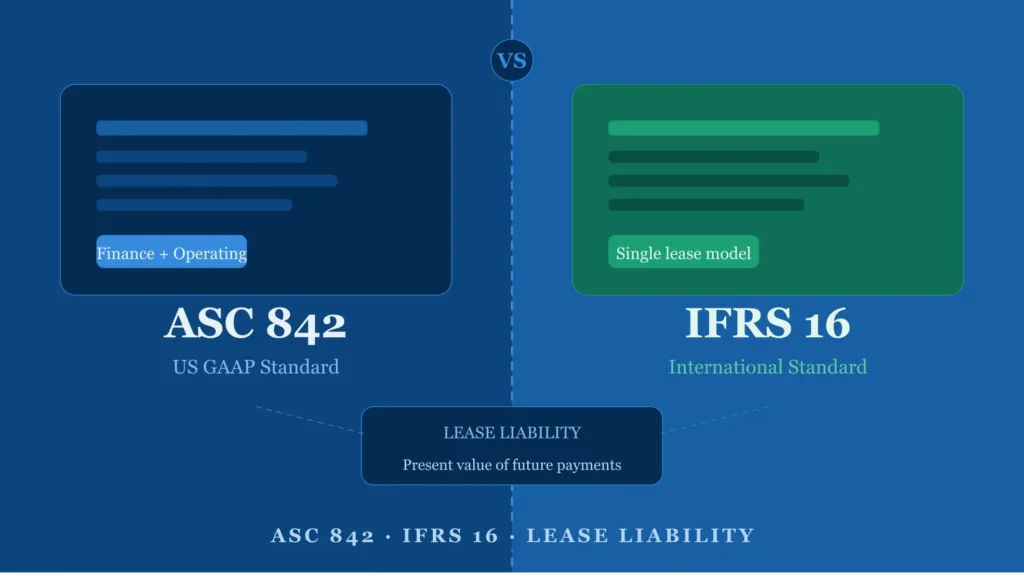
Alongside the ROU asset, you record a lease liability representing the obligation to make future lease payments. This is measured at the present value of outstanding lease payments, discounted using the interest rate implicit in the lease (or the lessee’s incremental borrowing rate if that’s not available).
Each month, the liability reduces as payments are made, while an interest charge is recognized in the income statement.
How to Identify a Lease Under IFRS 16
Not every contract is a lease. IFRS 16 says a contract contains a lease if it conveys the right to control the use of an identified asset for a period of time in exchange for consideration.
Ask yourself three questions:
- Is there an identified asset (specific equipment, property, or vehicle)?
- Does your company have the right to obtain substantially all the economic benefits from that asset?
- Does your company have the right to direct how and for what purpose the asset is used?
If yes to all three, congratulations, it’s a lease under IFRS 16.
Impact on Financial Statements
IFRS 16 touches all three major financial statements:
| Statement | Impact |
|---|---|
| Balance Sheet | Higher total assets (ROU assets) and higher total liabilities (lease liabilities) |
| Income Statement | EBITDA improves (rent expense replaced by depreciation + interest) |
| Cash Flow Statement | Lease payments split between operating and financing activities |
This is why companies in retail, aviation, shipping, and real estate saw some of the biggest changes, they hold enormous lease portfolios.
Key Measurement and Disclosure Requirements
Beyond initial recognition, IFRS 16 requires companies to:
-
- Reassess lease terms when there’s a significant event or change in circumstances
-
- Remeasure the lease liability when lease modifications occur
-
- Disclose maturity analysis of lease liabilities, depreciation charges, interest on lease liabilities, and short-term/low-value lease expenses
Transparency is the theme throughout. Investors should be able to clearly understand a company’s lease commitments just by reading the notes.
Common Challenges in Applying IFRS 16
Applying IFRS 16 isn’t always straightforward. Here are the pain points finance teams frequently encounter:
-
- Determining the lease term especially when renewal options exist
-
- Choosing the right discount rate particularly for companies without a clear borrowing rate
-
- Separating lease and non-lease components in contracts (e.g., a lease bundled with a maintenance service)
-
- Managing data across hundreds or thousands of lease contracts
Many mid-to-large companies now use dedicated lease accounting software to manage these complexities efficiently.
Quick Recap: IFRS 16 in 5 Key Points
-
- Nearly all leases go on the balance sheet as ROU assets and lease liabilities
- Exemptions exist for short-term and low-value leases
- The lease liability is measured at the present value of future payments
- Financial metrics like EBITDA, gearing ratios, and asset turnover all change
- Robust disclosures are mandatory, not optional
Final Thoughts
IFRS 16 was a game-changer for financial reporting. It created more honest, comparable balance sheets and gave investors a clearer picture of a company’s true obligations. Yes, it added complexity, but it also added clarity.
Whether you’re an accountant implementing this standard, a CFO reviewing its impact, or a business owner trying to understand your financials, getting comfortable with IFRS 16 is well worth the effort.
When in doubt, consult your auditor or a qualified IFRS specialist, lease accounting has enough nuances that expert guidance is always valuable.