
Introduction
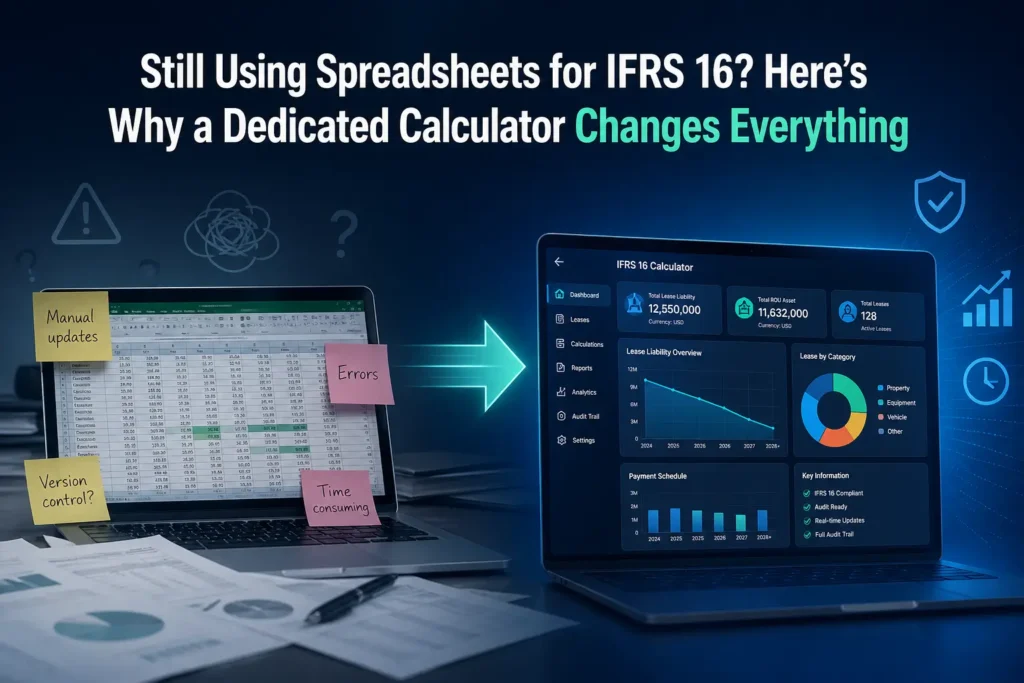
If your finance team is still crunching IFRS 16 numbers inside a spreadsheet, you are not alone. Many businesses, from small companies to large enterprises, started their lease accounting journey with Excel. It felt familiar, flexible, and free.
But here is the reality: IFRS 16 is not a simple standard. It involves complex calculations, regular reassessments, and strict disclosure requirements. Doing all of this inside a spreadsheet is like trying to run a restaurant using only a notepad. It works, until it doesn’t.
In this article, we will break down why spreadsheets fall short for IFRS 16 compliance and how a dedicated IFRS 16 calculator transforms the entire process for your accounting team.
What Is IFRS 16 and Why Does It Matter?
IFRS 16 is the international financial reporting standard for lease accounting. It came into effect in January 2019 and replaced the older IAS 17 standard. Under IFRS 16, companies must now recognize almost all leases on their balance sheets, both as a right-of-use asset and a lease liability.
This change impacts how your company reports assets, liabilities, depreciation, and interest expenses. Get it wrong, and you risk audit failures, restatements, and regulatory penalties.
The math involved is not trivial. Every lease requires:
-
- Calculation of present value of future lease payments
-
- Separation of interest and principal components
-
- Depreciation schedules for ROU assets
-
- Adjustments for modifications, renewals, and terminations
-
- Detailed note disclosures for financial statements
Now imagine doing all of this for 50, 100, or 500 leases inside a spreadsheet. That is where the problems begin.
The Real Problems with Using Spreadsheets for IFRS 16
1. Human Error Is Almost Inevitable
Spreadsheets are built by humans, and humans make mistakes. A single misplaced formula, a wrong cell reference, or a copy-paste error can corrupt your entire lease schedule. The famous “Excel error” that cost firms millions in financial misreporting is well documented globally.
With IFRS 16, a small input error can cascade into incorrect ROU asset values, wrong amortisation figures, and inaccurate liability disclosures. Auditors will find it. Regulators will flag it.
2. No Audit Trail or Version Control
Do you know who changed what and when in your IFRS 16 spreadsheet? Probably not. Spreadsheets lack a reliable audit trail. When your external auditor asks why a figure changed between quarters, you may not have a clear answer.
A dedicated IFRS 16 calculator maintains a full log of changes — who made them, when, and why. This is not just convenient. It is essential for compliance.
3. Lease Modifications Are a Nightmare
Under IFRS 16, any change to a lease — a rent increase, an extension, an early termination — triggers a lease modification. This requires recalculating the present value at the modification date using a new discount rate.
In a spreadsheet, this often means building a whole new tab, manually linking figures, and hoping nothing breaks. In a dedicated calculator, modifications are handled automatically with a few clicks.
4. Multi-Currency and Multi-Lease Management Gets Complicated Fast
Managing leases in different currencies, jurisdictions, or with different commencement dates makes spreadsheets exponentially harder to manage. Formulas get nested, tabs multiply, and the file slows down. A dedicated tool handles this cleanly and consistently.
5. Disclosure Reports Are Time-Consuming to Build
IFRS 16 requires detailed disclosures in your financial statements — maturity analysis of lease liabilities, weighted average discount rates, ROU asset movements, and more. Pulling this data from a spreadsheet manually is a slow, error-prone process every reporting period.
What a Dedicated IFRS 16 Calculator Does Differently
A purpose-built IFRS 16 calculator is designed from the ground up to handle every aspect of the standard. Here is what makes it a game-changer:
Automated Calculations, Every Time
Enter your lease data once — commencement date, lease term, payment amounts, discount rate — and the calculator instantly generates your amortisation schedule, ROU asset values, and liability breakdown. No formulas to maintain. No manual updates.
Built-in Compliance Logic
Dedicated tools are updated to reflect the latest interpretations and amendments to IFRS 16. You do not need to read every IASB update and translate it into spreadsheet formulas. The software does that for you.
Modification Handling Made Simple
When a lease changes, you update the relevant fields and the calculator automatically recalculates from the modification date. It handles partial terminations, lease extensions, and changes in scope — all in line with IFRS 16 requirements.
Ready-Made Disclosure Outputs
Need your maturity analysis or a reconciliation of opening and closing lease liabilities? A dedicated IFRS 16 calculator generates these reports with a single click, formatted for your financial statements.
Centralized Lease Register
Instead of multiple spreadsheet files shared across email, a dedicated tool stores all your leases in one centralized, searchable register. Everyone works from the same data, in real time.
Reduced Audit Risk
Clean data, clear audit trails, and standardized outputs reduce the time and stress of audit season. Your auditors can easily trace every number back to its source.
Who Benefits Most from a Dedicated IFRS 16 Calculator?
While any business with leases benefits, the impact is especially significant for:
-
- Mid-to-large companies with 10+ leases across multiple locations
-
- Property-heavy businesses such as retail chains, hospitality groups, and logistics firms
-
- Companies under external audit where disclosure accuracy is under scrutiny
-
- Finance teams with limited bandwidth who cannot afford to spend hours maintaining spreadsheet models each quarter
Making the Switch: Is It Worth It?
The short answer: yes — almost always.
The cost of a dedicated IFRS 16 calculator is typically far less than the cost of an audit error, a compliance failure, or the hours your team loses every quarter maintaining a spreadsheet that was never built for this purpose.
More importantly, it gives your finance team confidence. Confidence that the numbers are right. Confidence that disclosures are complete. Confidence that when the auditor calls, you have everything ready.
Final Thoughts
Spreadsheets are powerful tools, but they were not built for IFRS 16 compliance. The standard is too complex, too dynamic, and too consequential to trust to a set of manually maintained formulas.
A dedicated IFRS 16 calculator does not just make your life easier — it makes your reporting more accurate, your audits smoother, and your compliance more robust.
If your team is still copying and pasting lease payments into a spreadsheet every quarter, now is the time to make the switch. Your balance sheet will thank you.
Pingback: IAS 17 to IFRS 16: What Changed in Lease Accounting