Lease accounting used to be simple. Companies tracked rental contracts on basic spreadsheets, recorded monthly payments, and moved on.
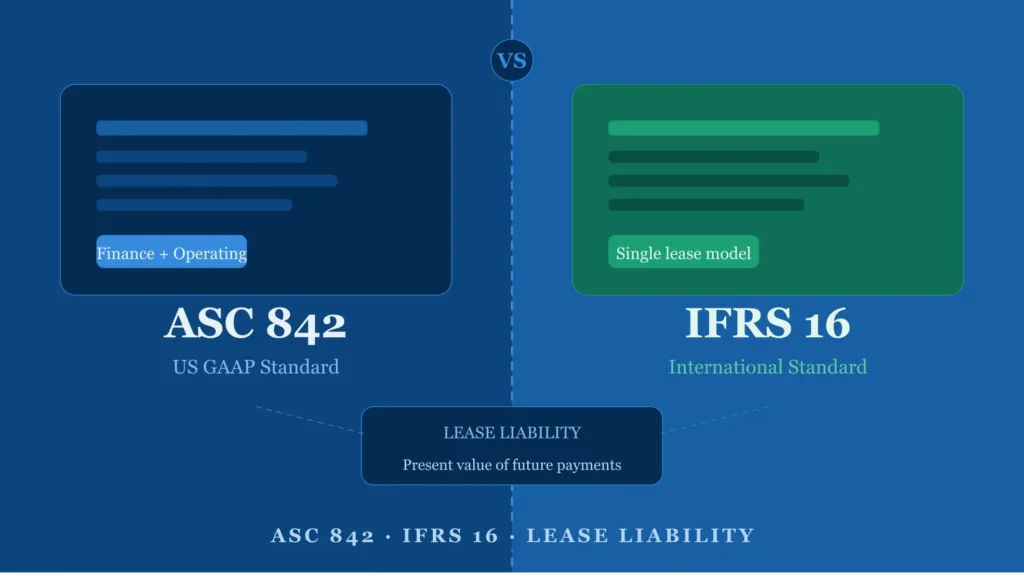
That all changed when the International Accounting Standards Board (IASB) introduced IFRS 16. Under this standard, nearly every lease must appear on your balance sheet as a Right-of-Use (ROU) asset and a corresponding lease liability.
Suddenly, accounting teams found themselves buried under hundreds of pages of complex contracts, changing discount rates, and messy recalculations.
Many software vendors now claim that artificial intelligence (AI) is the silver bullet. They promise that smart algorithms will instantly solve your workload.
Can AI actually simplify IFRS 16 compliance, or is it mostly marketing hype?
In this guide, we will separate real automation from sales pitch promises. You will learn where AI shines, where human oversight remains essential, and how to build an efficient lease accounting process.
What Makes IFRS 16 Compliance So Complex?
To understand how technology helps, we first need to look at why this standard creates so much manual work.
Under older rules (like IAS 17), operating leases stayed off the balance sheet. Modern accounting requires full transparency. Every building, vehicle, data server, and piece of office equipment must be measured and reported.
+------------------------+-------------------------------------------------------+
| Core Challenge         | Why It Creates Extra Work                             |
+------------------------+-------------------------------------------------------+
| Unstructured Documents | PDF contracts hide critical payment terms and dates.  |
| Ongoing Modifications  | Mid-term extensions or rent changes alter liabilities.|
| Interest Rate Updates  | Discount rates require constant recalculation.        |
| Multi-Currency Leases  | Global portfolios need frequent exchange rate adjustments.|
+------------------------+-------------------------------------------------------+
When you manage dozens or hundreds of contracts across different departments, spreadsheets quickly break down. Human data entry leads to missing dates, wrong formulas, and stressful audit cycles.
How AI Helps Simplify IFRS 16 Compliance
Artificial intelligence is not magic, but it excels at handling repetitive, structured data tasks. When applied correctly, smart software cuts manual data entry by up to 80%.
Here are the main ways modern AI software transforms the lease accounting workflow:
1. Automated Data Extraction (OCR + NLP)
Reading through 40-page lease agreements to find start dates, payment escalation clauses, and renewal options takes hours.
AI tools use Optical Character Recognition (OCR) and Natural Language Processing (NLP) to read PDF files or scanned documents. The software identifies critical fields like lease terms, monthly payments, and break options in seconds.
2. Instant Calculation of ROU Assets and Liabilities
Once data is extracted, AI algorithms calculate the present value of future lease payments.
The software automatically builds:
- Amortization schedules for the Right-of-Use asset.
- Interest expense schedules for the lease liability.
- Monthly journal entries ready for your Enterprise Resource Planning (ERP) system.
3. Continuous Modification Tracking
Leases change over time. Rent increases, office spaces downsize, and lease periods get extended.
When a modification happens, AI accounting platforms recalculate the balance sheet impact automatically. This eliminates the need to rewrite complex Excel formulas every time a landlord sends an addendum.
Separating the Hype from Reality: What AI Cannot Do
While tech vendors highlight full automation, complete hands-off compliance is a myth. AI is a tool that assists accountants, not a replacement for financial judgment.
The Limits of AI in Lease Accounting
+-----------------------------------+-----------------------------------+
| What AI Handles Well              | Where Human Experts Are Required  |
+-----------------------------------+-----------------------------------+
| Scanning PDF contracts            | Interpreting vague legal clauses  |
| Extracting dates and payment fees | Setting incremental borrowing rates|
| Running present value formulas   | Deciding if a renewal is likely   |
| Generating journal entry drafts   | Signing off on audit disclosures  |
+-----------------------------------+-----------------------------------+
Here is where human judgment remains critical:
- Determining Borrowing Rates: AI cannot independently choose the correct Incremental Borrowing Rate (IBR) for your business. Financial experts must evaluate credit risks and market conditions.
- Evaluating Renewal Options: Under IFRS 16, you must decide if your company is “reasonably certain” to exercise a lease extension. An algorithm cannot predict your company’s long-term business strategy.
- Handling Complex Legal Nuance: Some lease agreements contain ambiguous clauses or custom side-letters. Human eyes must review flagged items to ensure complete accuracy.
Key Takeaway: AI handles the tedious data collection, giving accountants more time to focus on strategic decisions and risk management.
4 Common Mistakes to Avoid When Automating
If you decide to adopt AI tools to simplify IFRS 16 compliance, watch out for these frequent mistakes:
- Trusting Data Extraction Without Human Verification: Never import AI-extracted data directly into your general ledger without human review. Always use a “human-in-the-loop” approval step.
- Ignoring Legacy Data Quality: If your existing lease documents are incomplete or missing signatures, AI will struggle. Clean your document archive before feeding contracts into new software.
- Choosing Standalone Tools That Do Not Connect to ERPs: Siloed software creates extra work. Ensure your AI lease tool connects seamlessly with your main accounting system (such as SAP, Oracle, or Microsoft Dynamics).
- Skipping Audit Trail Reviews: Auditors need to see how every number was calculated. Choose AI tools that offer click-through lineage from the general ledger back to the original sentence in the source contract.
Expert Tips to Simplify IFRS 16 Compliance Today
Here are practical tips from finance professionals to help you streamline your compliance setup:
- Standardize Future Lease Contracts: Work with your legal team to create template lease agreements. Standardized language makes it much easier for AI software to scan contracts with 99% accuracy.
- Centralize Document Storage: Gather all lease files from local branches, fleet managers, and real estate heads into one secure cloud folder before starting implementation.
- Establish Clear Verification Workflows: Assign specific team members to review AI extraction flags. Set a rule that high-value leases receive a double-check by a senior manager.
- Focus on Ongoing Maintenance: Compliance is an ongoing process, not a one-time project. Review your lease portfolio quarterly to catch modifications early.
Frequently Asked Questions (FAQs)
Q 1. How does AI software extract lease data from PDF contracts?
AI tools use Optical Character Recognition (OCR) combined with Natural Language Processing (NLP). The software scans scanned PDF documents, identifies key terms like payment schedules or start dates, and structures the text into clear digital fields for accounting calculations.
Q 2. Can small businesses benefit from AI lease accounting tools?
Yes, small businesses with more than five to ten leases can save significant time. Manual spreadsheets quickly become prone to formula errors as portfolios grow. Basic AI tools automate schedules and disclosures at an affordable price point.
Q 3. Does AI replace the need for professional accounting advice?
No, AI does not replace professional accountants. While AI automates data extraction and mathematical calculations, human experts must still evaluate complex contract terms, select discount rates, and sign off on final financial reports.
Q 4. How does AI handle lease modifications under IFRS 16?
When a lease agreement changes, AI software updates the underlying contract data and automatically recalculates the Right-of-Use asset and liability balances. It then generates updated journal entries, eliminating manual formula revisions.
Q 5. What should auditors look for in AI lease accounting software?
Auditors look for clear data lineage and complete audit trails. A strong AI solution allows auditors to click on any journal entry or balance and jump directly to the exact page and highlight in the source PDF contract.
Conclusion
So, can artificial intelligence actually simplify IFRS 16 compliance?
Yes, absolutely, provided you maintain realistic expectations. AI drastically reduces manual data entry, automates routine schedule calculations, and keeps your balance sheet audit-ready.
However, AI does not replace human professional judgment. The best approach combines fast AI document processing with expert accountant oversight.
Are you ready to streamline your financial reporting and eliminate spreadsheet stress? Explore modern, AI-assisted lease accounting software today to save time and protect your audit accuracy!