Managing small business finances can feel overwhelming, especially when accounting rules change. For a long time, small business owners could keep many equipment and property leases off their balance sheets. You simply recorded monthly lease payments as a regular operating expense on your profit and loss statement.
That changed with the arrival of IFRS 16 Leases.
If your business prepares financial statements using International Financial Reporting Standards (IFRS), you need to know how to account for leases under IFRS 16 correctly. Under this standard, almost all leases must appear directly on your balance sheet.
While this rule might sound complex, the basic accounting steps are straightforward once you break them down. In this guide, we will explain everything you need to know in plain English—from basic definitions and practical exemptions to step-by-step journal entries and common mistakes to avoid.
What Is IFRS 16 and Why Did the Rules Change?
IFRS 16 is an international accounting standard issued by the International Accounting Standards Board (IASB). It took effect on January 1, 2019, replacing the old lease standard known as IAS 17.
Under the old rules, leases were split into two categories:
- Operating Leases: Treated like rental agreements. The leased item stayed off the balance sheet, and monthly rent was recorded as an expense.
- Finance Leases: Treated like a purchased asset funded by a loan, appearing on the balance sheet.
This old approach created a major problem. Two companies could use identical delivery trucks or office spaces, but their balance sheets looked completely different based on how their contracts were worded. Investors and banks complained that companies hid massive financial commitments off their balance sheets.
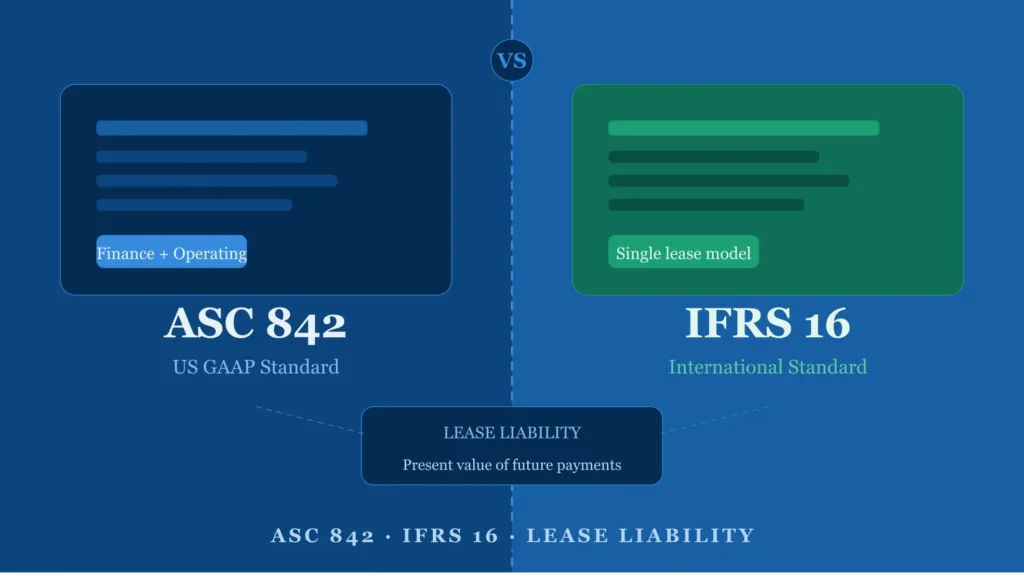
IFRS 16 solved this by removing the distinction between operating and finance leases for tenants (lessees). Now, almost all leases must be recorded on the balance sheet as both an asset and a liability.
Old Rule (IAS 17 Operating Lease):  Rent Payment ➔ P&L Expense (Off Balance Sheet)
New Rule (IFRS 16):                Lease Contract ➔ Asset + Liability on Balance Sheet
Do All Leases Fall Under IFRS 16? (The 2 Big Exemptions)
The good news for small businesses is that you do not have to apply these detailed rules to every single lease contract. IFRS 16 provides two voluntary, practical exemptions that save time and reduce accounting costs.
1. Short-Term Leases
A lease is considered short-term if it has a total lease term of 12 months or less at the start date.
- Rule: If a contract contains an option to buy the asset, it cannot be classified as short-term.
- Accounting Treatment: You do not place these on the balance sheet. Instead, you record payments as straight-line expenses over the lease period, just like the old operating lease rules.
2. Low-Value Asset Leases
If the underlying asset has a low value when brand new, you can bypass balance sheet recognition.
- Rule: Although IFRS standards do not state an exact dollar cap, the official guidance suggests assets valued around $5,000 USD or less when new qualify (for example, laptop computers, office phones, or small office furniture).
- Important Note: The asset must be low-value on its own, not because it is part of a larger group. Cars and machinery almost never qualify as low-value assets.
Takeaway for Small Businesses: If you rent an office printer worth $3,000 or lease a storage unit for 6 months, you can choose to skip IFRS 16 balance sheet accounting and simply book the monthly rent as an expense.
4 Essential Terms You Must Understand
To understand how to account for leases under IFRS 16, you need to become familiar with four key terms:
- Right-of-Use (ROU) Asset: This represents your legal right to control and use the leased physical item during the lease period. It is reported as an asset on your balance sheet.
- Lease Liability: This represents your financial obligation to make future lease payments. It is reported as a debt liability on your balance sheet.
- Discount Rate: The interest rate used to calculate the present value of future lease payments. Companies usually use their incremental borrowing rate (the interest rate a bank would charge them to borrow money for a similar item).
- Lease Term: The non-cancellable period of the lease, plus any extension periods that you are reasonably certain to exercise.
How to Account for Leases Under IFRS 16: Step-by-Step Process
Here is the exact step-by-step process your accounting team or bookkeeper must follow to record a lease on your balance sheet.
Step 1: Determine if the contract contains a lease
Check if the agreement gives you the right to control an identified asset for a set period in exchange for payment. If the supplier can easily substitute the asset, it may be a service contract rather than a lease.
Step 2: Calculate the initial Lease Liability
Find the present value of all future lease payments. Discount those payments back to Day 1 using your incremental borrowing interest rate.
Step 3: Calculate the initial Right-of-Use (ROU) Asset
Start with the Lease Liability amount from Step 2. Add any initial direct costs (like legal or broker fees) and upfront payments made to the landlord. Subtract any lease incentives received (like a cash bonus or initial free rent period).
Step 4: Record initial and ongoing journal entries
Book the asset and liability on Day 1. Over the lease term, record monthly interest on the liability, depreciation on the asset, and reduce the liability when cash payments are made.
Real-World Example: Accounting for a Small Business Office Lease
Let’s walk through a realistic numerical example to see how this works in practice.
The Scenario
- Company Name: Apex Retail Solutions
- Leased Asset: Commercial Office Space
- Lease Term: 3 years (36 months)
- Annual Rent Payment: $10,000 paid at the end of each year
- Incremental Borrowing Rate (Discount Rate): 5% per year
- Initial Direct Costs: $1,000 paid for legal setup fees
Step 1: Calculate the Present Value (Lease Liability)
To calculate the present value of $10,000 paid annually for 3 years at a 5% discount rate, we use the present value formula:
Present Value=t=1∑n(1+r)tPt
- Year 1: (1+0.05)1$10,000=$9,523.81
- Year 2: (1+0.05)2$10,000=$9,070.29
- Year 3: (1+0.05)3$10,000=$8,638.38
- Total Present Value (Initial Lease Liability): $27,232.48
Step 2: Calculate the Initial ROU Asset Value
ROU Asset=Initial Lease Liability+Initial Direct Costs−Incentives
- Initial Lease Liability: $27,232.48
- Plus Initial Legal Fees: $1,000.00
- Total Initial ROU Asset Value: $28,232.48
Step 3: Record the Day 1 Journal Entry
On the first day of the lease contract, Apex Retail Solutions books this initial entry:
| Account Name | Debit ($) | Credit ($) |
|---|---|---|
| Right-of-Use Asset (Office) | $28,232.48 | |
| Lease Liability | $27,232.48 | |
| Cash / Bank (Legal Fees Paid) | $1,000.00 |
Step 4: Record Subsequent Entries (Year 1)
During Year 1, two ongoing accounting actions occur:
- Depreciation on the Asset: The $28,232.48 ROU Asset is depreciated evenly over 3 years ($28,232.48 ÷ 3 = $9,410.83 per year).
- Interest Expense on Liability: Interest accrues on the $27,232.48 liability at 5% ($27,232.48 × 5% = $1,361.62).
Year 1 End Journal Entries:
To record annual depreciation expense:
- Debit: Depreciation Expense — $9,410.83
- Credit: Accumulated Depreciation (ROU Asset) — $9,410.83
To record the annual $10,000 payment and interest:
- Debit: Interest Expense — $1,361.62
- Debit: Lease Liability (Principal Reduction) — $8,638.38
- Credit: Cash / Bank — $10,000.00
At the end of Year 1, the remaining Lease Liability drops from $27,232.48 to $18,594.10 ($27,232.48 – $8,638.38).
Comparison: Old Accounting (IAS 17) vs. New Accounting (IFRS 16)
| Financial Statement | Old Standard (IAS 17 Operating) | New Standard (IFRS 16) |
|---|---|---|
| Balance Sheet | No asset or liability recorded. | Shows ROU Asset and Lease Liability. |
| Income Statement | Single rental expense line item. | Split into Depreciation Expense and Interest Expense. |
| Cash Flow Statement | Full payment shown under Operating Activities. | Principal payment under Financing; interest under Operating. |
| EBITDA Impact | Lower EBITDA (rent expense reduces EBITDA). | Higher EBITDA (interest and depreciation sit below EBITDA). |
Common IFRS 16 Mistakes Small Businesses Make
Transitioning to IFRS 16 can lead to errors if you are unprepared. Here are four common mistakes small businesses should watch out for:
- Forgetting non-lease components: Many lease contracts combine rent with maintenance or service fees. IFRS 16 allows you to separate service fees from lease payments so you do not overstate your balance sheet liability.
- Miscalculating the lease term: If your lease is for 3 years but gives you an easy option to extend for another 3 years that you fully plan to use, your lease term is 6 years, not 3.
- Using an incorrect interest rate: Selecting an arbitrary interest rate can distort your present value calculations. Document how you determined your incremental borrowing rate.
- Ignoring lease modifications: If your rent increases unexpectedly, or if you modify your square footage mid-contract, you must recalculate and update your ROU asset and lease liability balances.
Expert Tips for Smooth IFRS 16 Compliance
- Maintain a centralized lease register: Store all equipment, vehicle, and property lease contracts in one organized location. Track key dates, payment schedules, and renewal options.
- Leverage practical exemptions: Take full advantage of the short-term and low-value asset exemptions to reduce unnecessary balance sheet tracking.
- Use accounting calculator: Avoid relying solely on manual spreadsheets. Most modern IFRS 16 accounting calculator now includes built-in IFRS 16 calculation modules.
- Consult your auditor early: Discuss your proposed discount rates and lease classification assumptions with your accounting advisor before finalizing year-end reports.
Frequently Asked Questions
Q 1. Does IFRS 16 apply to all small businesses?
IFRS 16 applies to all businesses that prepare their financial reports using full IFRS standards or IFRS for SMEs (where applicable by jurisdiction). If your small business uses local reporting standards like US GAAP or local cash-basis rules, you follow those specific guidelines instead. Always confirm which accounting framework your bank or regulatory authorities require.
Q 2. How do I choose the right discount rate for IFRS 16?
Under IFRS 16, you should first try to use the interest rate implicit in the lease contract. If that rate cannot be easily determined—which is common for office space or equipment rentals—you must use your company’s incremental borrowing rate. This is the rate of interest your business would pay to borrow a similar amount of money over a similar term to purchase a similar asset.
Q 3. What happens when a lease contract is modified mid-term?
When a lease contract undergoes a modification, such as changing the space leased, extending the duration, or adjusting payment terms—you must remeasure the lease liability. You calculate the new present value using an updated discount rate on the modification date and adjust the corresponding Right-of-Use (ROU) asset account balance accordingly.
Q 4. Are software licenses covered under IFRS 16?
No, software licenses and intangible assets are generally excluded from IFRS 16. Intangible assets fall under IAS 38 Intangible Assets. While IFRS 16 permits companies to apply lease accounting to intangible assets, it is optional and rarely used for standard software subscriptions or software-as-a-service (SaaS) agreements.
Q 5. How does IFRS 16 impact key financial metrics like EBITDA?
IFRS 16 typically increases reported EBITDA (Earnings Before Interest, Taxes, Depreciation, and Amortization). Under the old rules, rent payments reduced operating income and lowered EBITDA. Under IFRS 16, rent is replaced by interest expense and depreciation expense. Since interest and depreciation are added back when calculating EBITDA, your EBITDA metric appears higher.
Conclusion
Understanding how to account for leases under IFRS 16 is essential for small businesses reporting under international accounting standards. While placing lease liabilities on your balance sheet adds extra steps to your bookkeeping routine, following the standard step-by-step model keeps your financial reporting compliant, transparent, and accurate.
Take time to review all active contracts, apply the short-term and low-value exemptions where applicable, and calculate present values using realistic borrowing rates. With organized records and clear procedures, IFRS 16 lease accounting becomes simple to manage.