
Medical bills and health expenses can sneak up on anyone. Managing these costs often feels like a balancing act between your health and your bank account.
If your employer offers special workplace benefits, you may have heard of a Flexible Savings Account, officially known as a Flexible Spending Account (FSA). This tool lets you set aside money before taxes to pay for medical care. But is it right for you?
In this guide, you will learn the advantages and disadvantages of a flexible savings account. We will break down how these accounts work, how they save you money, and the hidden traps to avoid.
What Is a Flexible Savings Account?
A Flexible Spending Account (FSA) is an employer-sponsored benefit. It allows you to put pretax dollars into a special account dedicated to medical and healthcare costs.
Because the money comes directly out of your paycheck before income tax is calculated, your overall taxable income drops. That means you pay less in taxes every pay period.
Gross Income: $4,000/mo ──> FSA Contribution: $200 ──> Taxable Income: $3,800
You can use FSA funds for everyday medical needs, including:
- Doctor copays and insurance deductibles
- Prescription medicines
- Eye exams, glasses, and contact lenses
- First-aid supplies, sunscreen, and dental care
The Core Advantages of a Flexible Savings Account
Understanding the advantages and disadvantages of a flexible savings account helps you maximize every dollar. Let’s start with the major benefits.
1. Instant Tax Savings
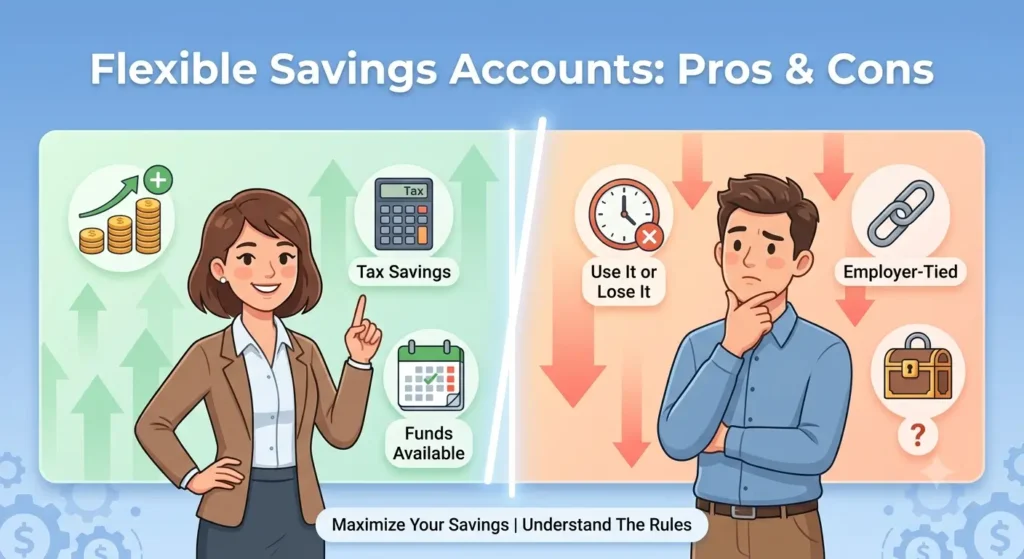
The primary benefit of an FSA is lower income taxes. Every dollar you deposit reduces your taxable earnings. If you are in a 22% tax bracket and contribute $2,000, you save around $440 in federal income taxes alone.
2. Full Balance Available on Day One
Unlike a standard savings account where funds build gradually, your entire annual FSA contribution is available immediately at the start of the plan year. If you pledge $2,400 for the year, you can spend $2,400 on January 1st—even though you have only made one small paycheck contribution.
3. Convenient Spending Options
Most FSA providers issue a dedicated debit card linked to your account. You can swipe the card directly at pharmacies, vision centers, and clinics without filing manual paperwork.
| Feature | Flexible Savings Account (FSA) | Standard Savings Account |
| Tax Status | Pretax money (Tax-free spending) | After-tax money |
| Fund Access | Full annual amount on Day 1 | Only what you have deposited |
| Rollover | Strict limits (“Use-it-or-lose-it”) | Unlimited rollover forever |
| Ownership | Tied to your employer | Owned individually by you |
Disadvantages of a Flexible Savings Account
While tax savings sound great, you must weigh them against significant rules and restrictions.
1. The “Use-It-or-Lose-It” Trap
The biggest drawback is that unused funds do not roll over indefinitely. If you contribute $1,500 and only spend $1,000 by the deadline, your employer keeps the remaining $500.
Important Rule: Some employers offer a 2.5-month grace period or allow a small rollover (around $640–$660 depending on the tax year), but they are not required to offer either.
2. You Cannot Take It With You
FSAs belong to your employer, not you. If you quit your job, get laid off, or retire, you forfeit any leftover balance in your account.
3. Contribution Limits
The IRS caps how much you can contribute each year (typically around $3,200 to $3,400 depending on federal inflation adjustments). You cannot store unlimited money in an FSA.
Expert Tips for Managing an FSA
If you decide to open an account, use these practical tips to keep your cash safe:
- Calculate Previous Health Costs: Look at last year’s receipts for prescriptions, dental visits, and contacts. Only budget for predictable costs.
- Track the Calendar: Mark your calendar for plan deadlines so you never leave money behind at year-end.
- Keep Every Receipt: Even with a debit card, your provider may ask for proof that purchases were qualified medical expenses.
- Stock Up Late in the Year: If you have leftover money near the deadline, purchase eligible items like prescription sunglasses, bandages, or saline solution.
Frequently Asked Questions
Q 1. What happens to my flexible savings account money if I quit my job?
If you leave your company, you forfeit any remaining funds in your health FSA. The account is tied to your employment, so you cannot take the money with you. However, if you spent your entire balance before leaving, you do not have to pay back the difference.
Q 2. Can I change my FSA contribution amount during the middle of the year?
Generally, no. The IRS requires you to lock in your contribution amount during your employer’s open enrollment period. You can only change your contribution mid-year if you experience a qualifying life event, such as marriage, divorce, or the birth of a child.
Q 3. What items can I purchase with flexible savings account funds?
FSA funds cover a wide variety of medical expenses. Eligible items include doctor copays, prescription drugs, dental care, eyeglasses, contact lenses, bandages, sunscreen, and acupuncture. Insurance premiums are not eligible expenses.
Q 4. Is a Flexible Savings Account (FSA) the same as a Health Savings Account (HSA)?
No, they are distinct accounts. HSAs require a High-Deductible Health Plan (HDHP), and the money rolls over permanently year after year. FSAs are open to broader employer plans, but they feature annual spend-down deadlines and employer ownership.
Q 5. What is the FSA grace period and how does it work?
An FSA grace period gives you up to 2.5 additional months after the plan year ends to spend remaining funds. Employers are not required to offer a grace period, so check your specific plan rules to avoid forfeiting unused money.
Conclusion
Weighing the advantages and disadvantages of a flexible savings account comes down to predictability. If you have steady medical bills, glasses, or regular prescriptions, an FSA lowers your tax bill instantly. However, if your medical needs are uncertain or you plan to change jobs soon, the “use-it-or-lose-it” rule could cost you money.
Review your medical bills from the past year, estimate your upcoming health expenses carefully, and ask your HR representative about plan limits today!